Monday, September 29, 2014

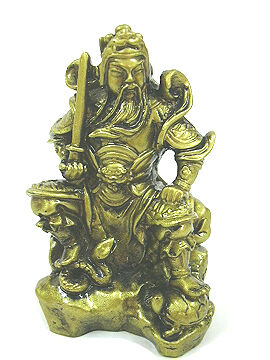
Xuan Wu Da Di

I am interested in the female aspect of this deity as described by Faustus Crow in the tale of Dr. Strange.
http://faustuscrow.wordpress.com/tag/xuan-wu-da-di/


Xuan Wu (god)

From Wikipedia, the free encyclopedia

Xuan Wu

Amulets that were blessed under Xuan Wu
Xuan Wu (玄武, lit. "Dark" or "Mysterious Warrior") is one of the higher-ranking Taoist deities. He is revered as a powerful god, able to control the elements and capable of great magic. He is particularly revered by martial artists and is patron saint of Hebei, Manchuria and Mongolia. As some Cantonese and Min Nan speakers (particularly Hokkien) fled into the south from Hebei with the Song dynasty, Xuan Wu is also widely revered in Fujian and Guangdong as well as among the Chinese diaspora.
Since the usurping Yongle Emperor of the Ming dynasty claimed the help of Xuan Wu during his successful Jingnan Campaign against his nephew, he had monasteries constructed in the Wudang Mountains of Hubei, China. where Xuan Wu allegedly attained his immortality.

Other Names

Xuan Wu is also commonly known as the Northern Emperor (北帝, Modern Pinyin Beidi, Cantonese Pak Tai) and Imperial Lord (帝公, Modern Pinyin Digong, Hokkien Teh Kong).
He is sometimes referenced as the Dark or Mysterious Heavenly Upper Emperor or God (玄天上帝, Xuantian Shangdi) and as the Truly Martial Grand Emperor (真武大帝, Zhenwu Dadi).

Stories

The original story

One story says that Xuan Wu was originally a prince of Jing Le State in northern Hebei during the time of the Yellow Emperor. As he grew up, he felt the sorrow and pain of the life of ordinary people and wanted to retire to a remote mountain for cultivation of the Tao.

Qing Dynasty's version

Another says that Xuan Wu was originally a butcher who had killed many animals unremorsefully. As days passed, he felt remorse for his sins and repented immediately by giving up butchery and retired to a remote mountain for cultivation of the Tao.
One day while he was assisting a woman in labor, while cleaning the woman’s blood stained clothes along a river, the words "Xuan Tian Shang Di" appeared before him. The woman in labor turned out to be a manifestation of the goddess Guan Yin. To redeem his sins, he dug out his own stomach and intestines and washed it in the river. The river turned into a dark, murky water. After a while, it turned into pure water.
Unfortunately, Xuan Wu did indeed lose his own stomach and intestines while he washing them in the river. The Jade Emperor was moved by his sincerity and determination to clear his sins; hence he became an Immortal known with the title of Xuan Tian Shang Ti.
After he became an immortal, his stomach and intestines after absorbing the essences of the earth, it was transformed into a demonic turtle and snake which harmed people and no one could subdue them. Eventually Xuan Wu returned to earth to subdue them and later uses them as his means for transportation.

Generals Wan Gong and Wan Ma


Zhenwu (Xuan Wu) with the two generals, and the Snake and Tortoise figures at his feet. Wudang Palace, Yangzhou
Xuan Wu is sometimes portrayed with two generals standing besides him, General Wan Gong (萬公) and General Wan Ma (萬媽). Most temples that are dedicated Xuan Wu also have Generals Wan Gong and Wan Ma, especially in Malaysia. The two generals are deities that handles many local issues from children's birth, medication, family matters as well as feng shui consultation. The Malaccans particularly in Pokok Mangga and Batu Berendam County have deep faith in the generals due to their much good deeds and contribution to the local villagers.

Cult

Depiction

Xuan Wu is portrayed as a warrior in imperial robes, his left hand is in the "three mountain hand seal", somewhat similar to Guan Yu's hand seal, while the right hand holds a sword, which is said to have belonged to Lü Dongbin, one of the Eight Immortals.
Another legend says that he borrowed the sword from Lü Dongbin to subdue a powerful demon, and after being successful, he refused to bring it back after witnessing the sword's power. The sword itself would magically return to its owner if Xuan Wu released it, so it is said that he always holds his sword tightly, and is unable to release it.
He is usually seated on a throne with the right foot stepping on the snake and left leg extended stepping on the turtle. His face is usually red with bulging eyes. His birthday is celebrated on the third day of the third lunar month.

Xuan Tian Shang Di in Indonesia

In Indonesia, almost every Taoist temples provides an altar for Xuan Tian Shang Di. The story states that the first temple that worshiped him was a temple at Welahan Town, Jepara, Central Java. And the temples that was built in honor of him are the temple at Gerajen and Bugangan, Semarang City, Central Java. His festival is celebrated annually every the 25th day, 2nd month, of Chinese calendar.[1] The worshipers of Chen Fu Zhen Ren, especially at De Long Dian Temple, Rogojampi, Banyuwangi Regency, East Java, believes that Xuan Tian Shang Di is their patron’s spiritual teacher. That’s why they put his altar at the right side of Chen Fu Zhen Ren’s altar, in the middle room of the temple which is always reserved for the main deity of klenteng (a specific term for Chinese temple in Indonesia.

Popular culture

  • In the classic novel Journey to the West, Xuan Wu was a king of the north who had two generals serving under him, a "Tortoise General" and a "Snake General". This king had a temple at Wudang Mountains in Hubei, thus there is a Tortoise Mountain and a Snake Mountain on the opposite sides of a river in Wuhan, the capital of Hubei.
  • In recent times, Xuan Wu is a central character in the popular urban fantasy series' by Kylie Chan: The Dark Heavens Trilogy and the Journey to Wudang Trilogy.

See also

  • Black Tortoise or Turtle, the Chinese mythological figure and astronomical symbol known by the same name

References

  1. Buddhist Temple Jin De Yuan Jakarta. 2012. Taken= March 14th, 2013. Hian Thian Siang Te – Dewa Langit Utara

External links

http://en.wikipedia.org/wiki/Xuan_Wu_%28god%29

https://heathenchinese.wordpress.com/tag/xuan-tian-shang-di/


Xuan Wu is the god of martial arts. His other names include: John Chen, Dark Lord, Xuan Tian Shang Di, and Zhen Wu Da Di. He is also the Northern Wind, and the leader of the Winds.

BACKGROUNDEdit

Xuan Wu is the creator of all martial arts. When he was Raised, the two parts of him, the Snake and the Turtle, were left behind. They caused havoc, killing travellers, and stealing women to keep as sex slaves. When Xuan Wu came back, he fought the Snake and the Turtle, absorbing them back into himself. He is the only Shen who has two creatures. After this, he travelled the Celestial Plane, finding the other Winds, throwing them down from their positions of power, and then making them swear fealty to himself.
He continued his life as a Shen, until he met Michelle, a mortal woman. He married Michelle, and stayed on the Mortal Plane with her, thus draining himself of power. He had a daughter with her, named Simone. When Michelle's parents came to visit, Xuan Wu decided to travel to his Mountain on the Celestial plane, for a short while. While he was gone, a Demon Prince, named Simon Wong broke in, incapacitated Leo, Michelle's bodyguard, killed Michelle's father and brothers, and kidnapped Michelle and her mother. He seemed unaware of Simone, and so left her alone. Simon Wong was unaware of how fragile humans are, and so raped Michelle and her mother until they 'broke.' When Xuan Wu came home, he was devestated, but held it together for Simone's sake. http://kyliechan.wikia.com/wiki/Xuan_Wu


Sunday, July 20, 2014

Goddess of the Highlands


Mẫu Thượng Ngàn

From Wikipedia, the free encyclopedia
Lâm Cung Thánh Mẫu (林宮聖母) or Mẫu Thượng Ngàn or Bà Chúa Thượng Ngàn (Princess of the Forest) is ruler of the Forest Palace among the spirits of the Four Palaces in Vietnamese indigenous religion.[1] In legend the Princess of the Forest was the daughter of prince Sơn Tinh and Mỵ Nương, công chúa Quế Mỵ Nương King Hung's daughter from the legend of the rivalry between Sơn Tinh and the sea god Thủy Tinh.[2] Many natural features around Vietnam feature shrines to her, such as the Suối Mỡ thermal springs area near the town of Bắc Giang.[3]

Goddess of the Highlands

References

  1. Hy V. Luong - Tradition, Revolution, and Market Economy in a North Vietnamese ... - Page 3072010 "In Sơn-Dương, many of the non-Buddhist deities — mẫu thượng thiên (goddess of the upper sky), mẫu thượng ngàn (goddess of the highlands), mẫu Thoải (goddess of water), Hắc hổ (black tigers), etc.— were worshipped in the house.."
  2. Tuyé̂t Thanh Lê Phụ nữ miè̂n nam Page 12 1993 "Among the popular Goddesses, there were many famous Goddesses such as Ba Chu Thuong Ngan (Princess of Forest) who was the daughter of Son Tinh and My Nuong (King Hung's daughter). Mrs Mau Thoai was the sea King's wife who"
  3. Minh trị Lưu Historical remains & beautiful places of Hanoi and the surrounding area Page 268 2000 "Suối Mơ Relics is in Nghia Phương commune, Lục Ngạn district, 37 km from Bắc Giang town. It is dedicated to God of the soil, Lady Lord of Forestry princess Quế Mỵ Nương, daughter of the 16th Hùng King."

Wednesday, June 18, 2014

Lady Linshui Temple

Lady Linshui Temple

Lady Linshui Temple in Tainan. This Goddess is believed to protect fetuses and small babies.
 
http://photos.taiwan-guide.org/index.php/tainan-temples/lady-linshui-temple
 
Lady Linshui
 
Lady Linshui (Chen Jing-gu)
Provided by National Museum of Taiwan History

Temple of Lady Linshui
Photo by Huang Xianjin. Provided by Wordpedia.com

Lady Linshui is worshipped in Fujian (福建) province in China as the patron goddess of women and children. She is also known, among other names, as “Chen Jinggu (陳靖姑),” “Great Lady,” “Shunyi furen (順懿夫人, Lady of Good Virtue)” and “Shuntian shengmu (順天聖母, Holy Mother Who Follows the Will of Heaven).” She is also, together with the “Second Mother Lady Lin (二媽林夫人)” and the “Third Mother Lady Li (三媽李夫人),” one of the “Sannai furen (三奶夫人, Three Ladies).” Gazetteers and legends from the Ming (明) Dynasty (1368–1644) and Qing (清) Dynasty (1644–1912) tell us that Lady Linshui lived during the Dali (大曆) period (766–779) of the Tang (唐) Dynasty (766–779) and that she followed the Daoist teachings of the Xu Xun’s (許遜) Lushan Sect (閭山派), learning their magical arts. She possessed the ability to exorcise demons and to drive out evil spirits; “Killing the white snake” and “gathering the demons” are counted among her legendary achievements. Later, Lady Linshui rescued Fujian from a long lasting drought by giving birth while praying for rain and thereby conjuring rain. However, she was not careful and Changkeng ghost (長坑鬼) and other demons saw what she was up to. They took on human shape and made their way to her family’s mansion. There they grabbed and devoured Lady Linshui’s baby. This at once killed Lady Linshui, who was in the middle of her conjuration. She bled to death aged just twenty-four as her baby was eaten. As Lady Linshui died, in the throes of difficult labor, she proclaimed: “After my death, I will save women in difficult labor or otherwise I will not be a goddess.”Thereafter, she was worshipped as patron goddess of pregnancy, easing labor, raising children and expelling demons. In temples and shrines the likenesses of the goddess are usually displayed in a seated position and placed in a prominent position. Sometimes she is portrayed holding a child, but in some temples she can also be found on murals and landscape art in a prominent position, seated, wearing the robes of a Daoist priest, holding a sword in hand, recalling her legendary killing of the demonic snake. These two images show her dual nature, warm and gentle, but also hard and martial.
The earliest accounts of worship of Lady Linshu can be found in Zhang Yining’s (張以寧)Yuan (元) Dynasty (1271–1368) text Shunyi Temple Inscription (順懿廟記). The text recounts how the Song (宋) Dynasty county magistrate Hong Tianxi (洪天錫) erected a memorial tablet to the goddess, showing that worship of Lady Linshui dates back to the Song Dynasty. In Taiwan worship of Lady Linshui began with the immigrant society under Qing rule. According to Taiwanese gazetteers and historical documents the first temple was the Linshui Temple in Baihe (白河) Township in Tainan (臺南) County. According to an inscription on a stone stele at the side of the temple dates from the first year of Emperor Yongzheng’s (雍正) reign (1723).
The birthday of the goddess Lady Linshui is the 15th day of the 1st month of the Chinese lunar calendar, that of Lady Lin is the 15th day of the 8th month and Lady Li’s birthday is the 9th day of the 9th. The most significant ritual activities related to the Three Ladies take place on these dates and various temples, such as the Fenxiang (分香) Temples, Fenling (分靈) Temples, Jiaotou Temples (角頭廟) and the local temples of the interacting boundaries (交陪境) all participate. The activities to promote fellowship between the various temples and their deities reveal much of the power structures between local temples. Rituals to protect children from demons, fertility rituals (栽花換斗), the coming of age ceremony for sixteen year-olds (做十六歲) and adopting sons are all ceremonial activities that commonly take place in these temples.

Copyright © 2011 Council for Cultural Affairs. All Rights Reserved.
English Keyword
Guan Yu , Three Kingdoms , Sacred Emperor of balancing literacy , Teacher of Shanxi Province
References
  1. He, Qiaoyuan. (1995). Min shu, Vol.1-5 [閩書(五冊)]. Ba min wen xian cong kan. Fuzhou: Fujian People's Publishing House.
  2. Huang, Zhongzhao. (Ed.). (1991). Ba min tong zhi, Vol.1-2 [八閩通志(兩冊)]. Fu jian di fang zhi cong kan. Fuzhou: Fujian People's Publishing House.
  3. Lin, Xianji., et al. (1967). Gu tian xian zhi [古田縣志]. Zhong guo fang zhi cong shu, No. 100. Taipei: Cheng Wen Publishing Co., Ltd.
  4. He, Qiuzuan. (1987). Min dou bie ji, Vol.1-3 [閩都別記(三冊)]. Fuzhou: Fujian People's Publishing House.
  5. Xie, Jinluan. (Ed.). (1977). Xu xiu tai wan xian zhi [續修臺灣縣志]. Tai wan wen xian shi liao cong kan di er ji, No. 32. Taipei: Datong Bookstore.

    Lady Linshui
    臨水夫人 中文版本

    Classification:Religion > Worship and Religion > Orthodox Deities > Lady Linshui
    Contributor: Kang Shihyu   
 
 
http://taiwanpedia.culture.tw/en/content?ID=4428
 
 
http://maisappho.wordpress.com/2013/08/28/lady-linshui-daughter-of-kuan-yin/